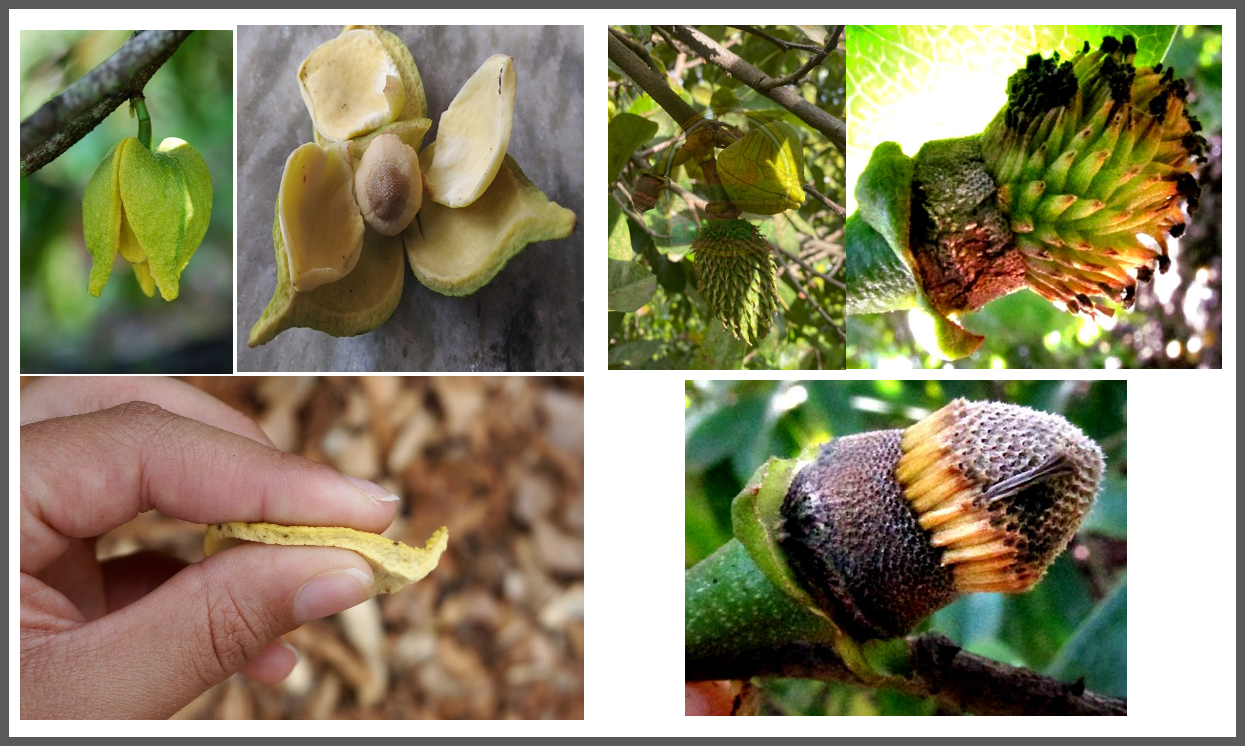
SOURSOP TREE FLOWERING


Soursop belongs to Annonaceae family. Being a primitive family, it does not produce colourful flowers but it develops green flowers which are not so attractive to insect and pest pollinators.


Flowering in the Soursop tree is a beautiful spectator event. This amazing Soursop tree receives flowers right on the stem and branches as very few plants in the plant kingdom.

These flowers turn into fruits after successful pollination. Interestingly, the size of the fruit is humongous, weighing about 3 to 6 kg depending upon the climatic conditions where the tree is growing. The picture in the frame says it all.

Comments

Popular posts from this blog

ANTIVIRAL PROPERTY OF SOURSOP

  A nnona muricata  L. is a tropical tree that is used in traditional medicine around the world. The high content of flavonoid, alkaloid, acetogenin, phenolic, and lipophilic compounds of this tropical tree forms the basis of its traditional medical uses. According to 49 research articles studied, the pharmacological properties of Soursop are reported to include 8% antiviral properties. Ethanolic extracts from the stem and bark of  A. muricata  showed in vitro antiviral activity against herpes simplex virus (ref. Padma, P.; Pramod, N.P.; Thyagarajan, S.P.; Khosa, R.L. Effect of the Extract of Annona muricata and Petunia Nyctaginiflora on Herpes Simplex Virus. J. Ethnopharmacol. 1998, 61, 81–83.) Acetogenins such as annomuricin a, annomuricin b, annomuricin c, muricatocin c, muricatacin, cis-annonacin, annonacin-10-one, cis-goniothalamicin, arianacin, and javoricin were shown to possess good inhibitory activity against SARS-CoV-2 spike proteins (in silico). Cis-a...

SOURSOP ON DIABETES

                                    ANTIDIABETIC PROPERTIES OF SOURSOP After every meal, there is a rise in the blood sugar due to the breakdown of carbohydrates into Glucose, which enters blood bloodstream. In healthy individuals, after about an hour post meal, blood glucose levels peak and return to normal within 2 to 3 hours, with levels rarely exceeding 140 mg/dL. In people with diabetes, this rise can be more pronounced and prolonged, sometimes exceeding 180 mg/dL.  Soursop fruit and plant parts have been used for the management of Diabetes for years. The folkloric use in Diabetes is supported by the fact that, studies carried out on Soursop in vitro, it has been found that Soursop fruit and Soursop plant part extracts show inhibitory effect on 𝛼 -amylase and 𝛼 -glucosidase. Reducing the postprandial hyperglycemia is an important strategy for type 2 Diabetes managemen...

ANTI INFLAMMATORY PROPERTY OF SOURSOP

  Due to significant side effects of steroid and non steroidal Anti-inflammatory Drugs (NSAID), there is an increasing interest in herbal remedies that have been in use for many years to minimize pain and inflammation. The great number of natural compounds work similarly to that of the NSAIDs. The mechanism of antinociception (reduced sensitivity to pain) has been shown to inhibit cyclooxygenase (COX) and lipoxygenases (LOX) through inflammatory mediators such as flavonoids present in the plant extract. The anti-inflammatory effects of Annona muricata are thus demonstrated to occur through suppression of inflammatory mediators. A. muricata produced dose-dependent and significant results, which were comparatively similar to the inhibition of inflammatory pain produced by morphine (96.08%) standard reference drug. The effect of the extract in this phase suggests that it may have an anti-inflammatory property. In conclusion, findings from the results of the studies showed th...